CW for violence, PTSD, white supremacy
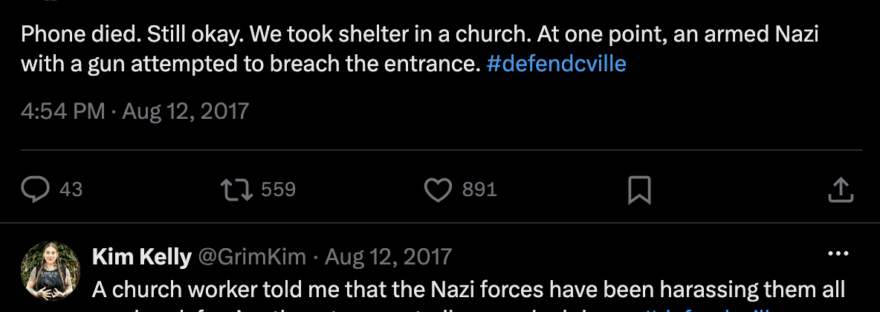
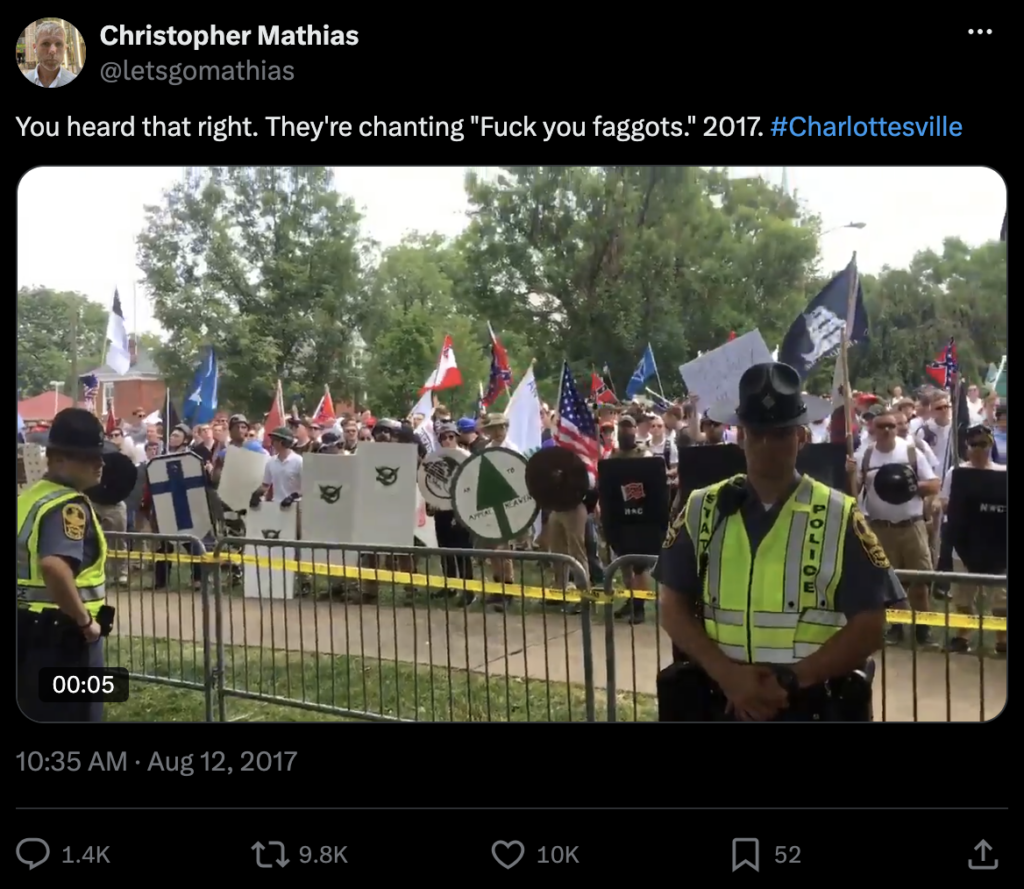
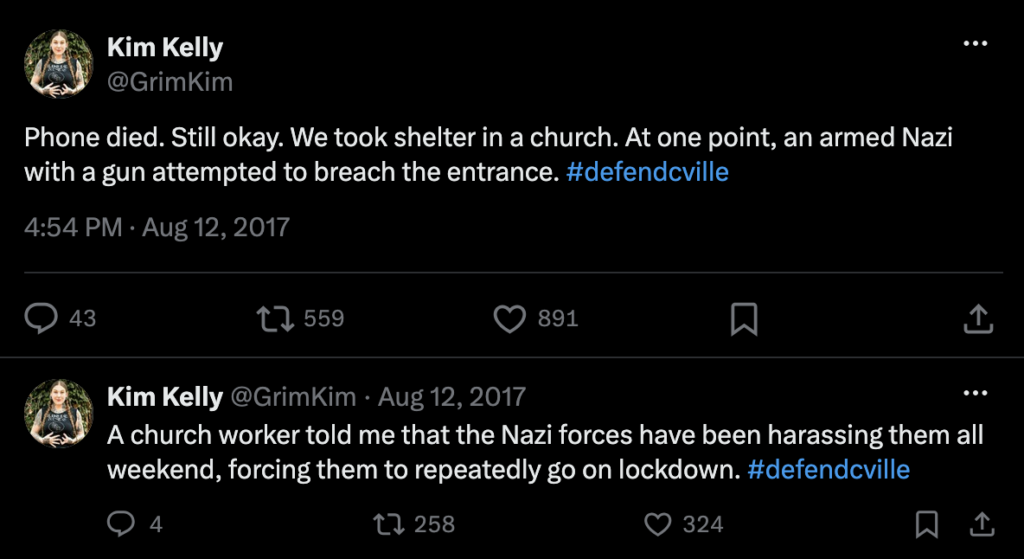
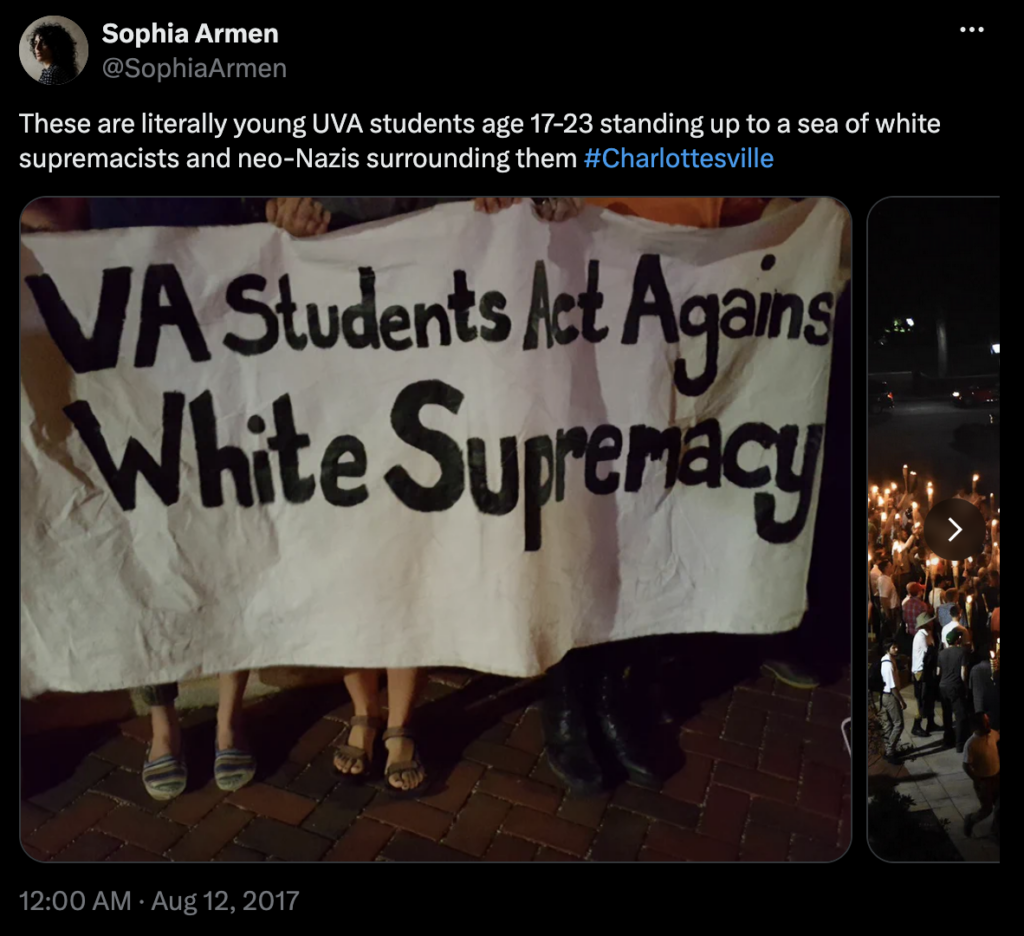
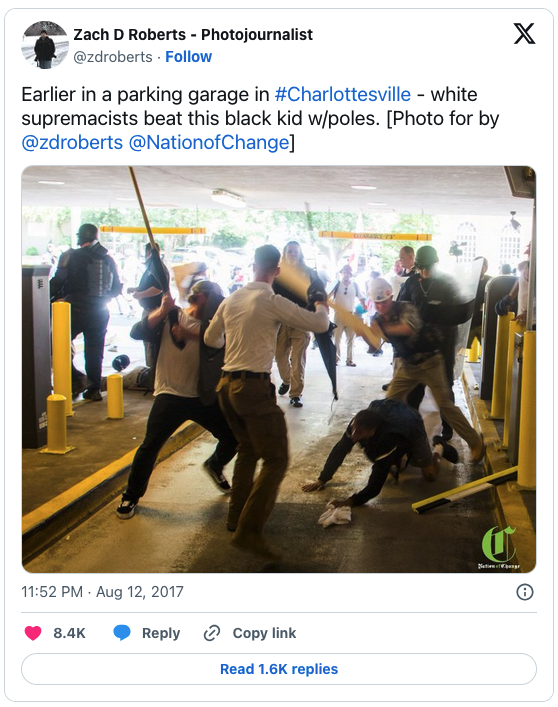
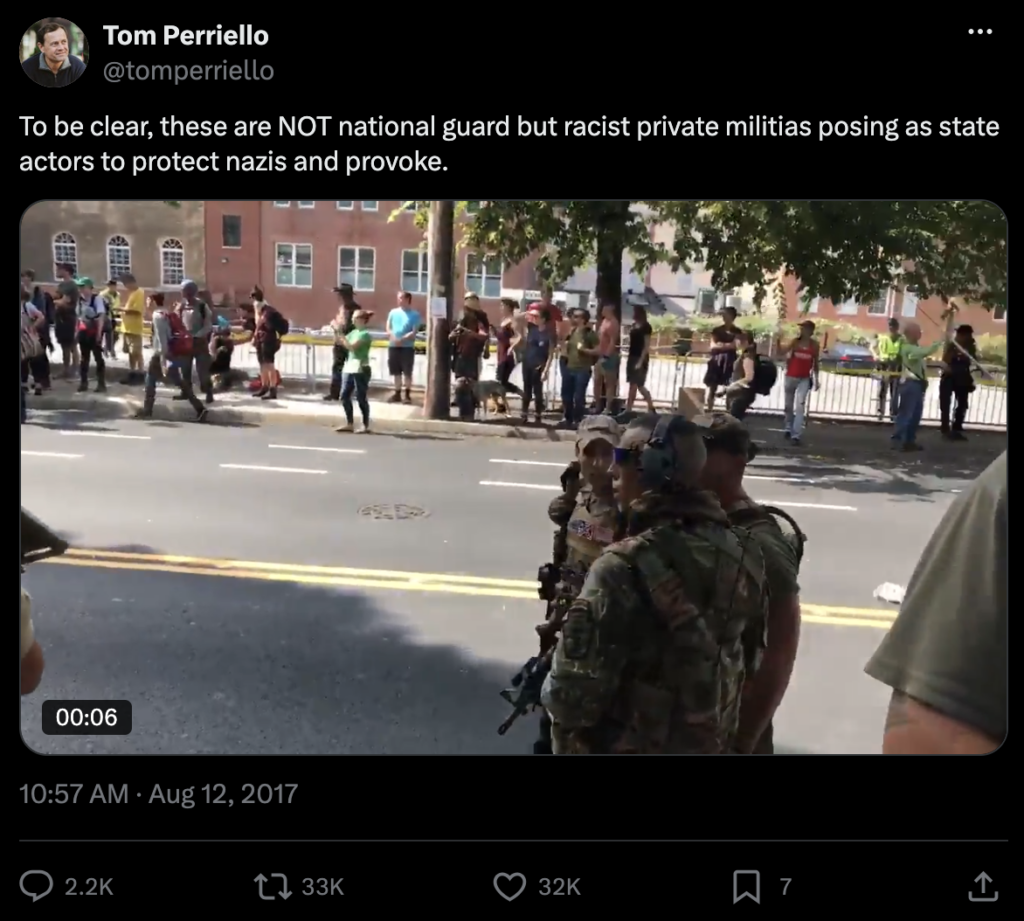
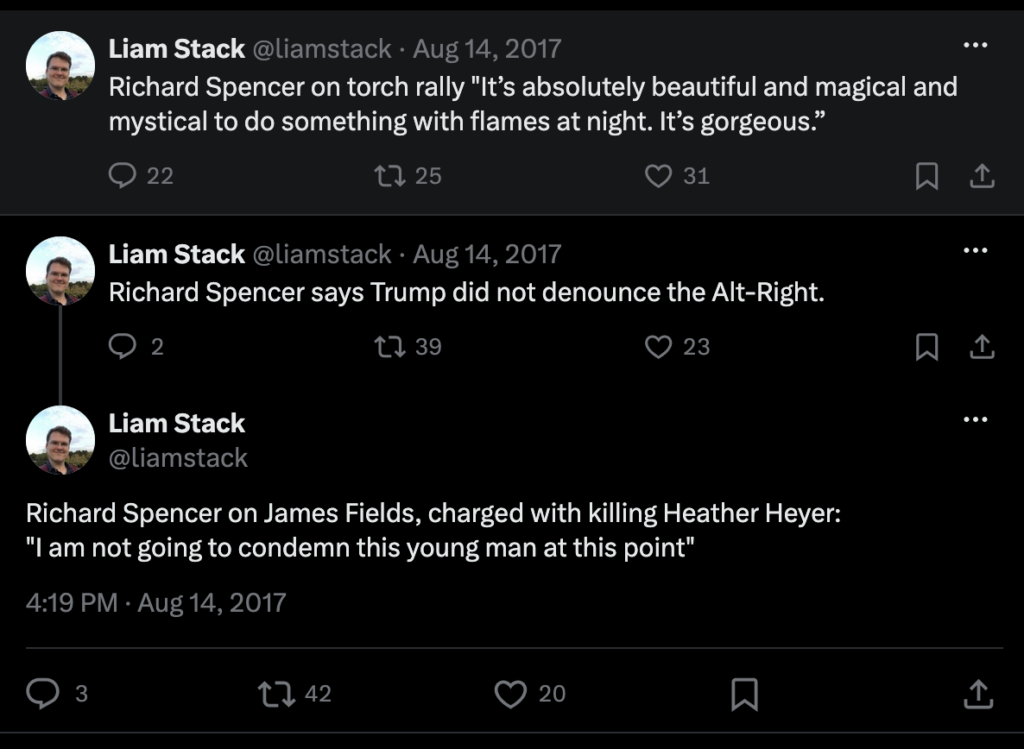
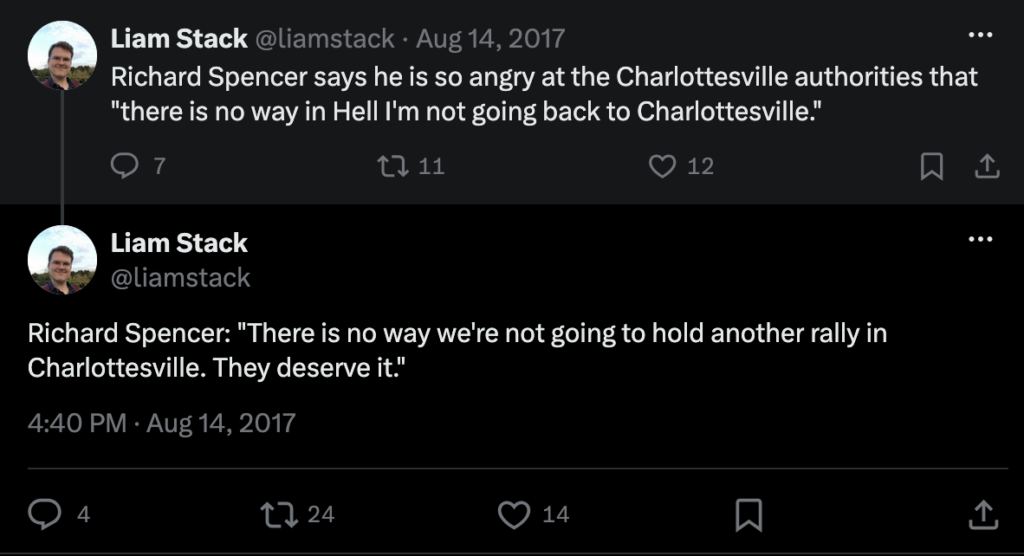
Nine years ago today was the Unite the Right rally in Charlottesville, where 35 people were injured and one was murdered when a white supremacist used his car as a weapon against a crowd of people. At least 14 other people were injured by the neo-Nazis and their ilk roaming the streets, trying to break into synagogues with guns, etc.
Every August for the last two or three years I’ve thought about writing something to mark the anniversary, but it never felt right. This year, it does, although I’m not sure why. Nine is a sacred number in my worldview; I’ve read theories it was also used as a stand in for things beyond number. There are nine worlds, so there are countless worlds. Some days it feels like Charlottesville was a few weeks ago, some days it feels like it was so long ago I can’t remember if I was the same person before it. Maybe it’s appropriate that this is the year when the words want to be heard.
We tend to think of time as linear, but we live in cycles. Today there’s a solar eclipse. Nine years ago, there was also a solar eclipse in August. Granted, then it was on August 21st, instead of August 12th — nine days after Charlottesville and the day before I started the drive back to Austin.
The night before the eclipse, I had a dream. I remember being on a battlefield frozen in time, bathed in eerie purple light as the moon hung low and huge on the horizon, pinned in place. I walked through the battlefield, staring at faces as I passed them. Some people were dressed in modern clothes, some in clothes from 50 or 100 or 200 years ago. One side had some people I recognized from Charlottesville, wearing cosplay tactical gear with red swastika armbands. I didn’t know what to do or how to help — not by making the fighting stop, but rather by restoring motion to the scene. The stillness was deeply unsettling in the way that makes your bones itch; this wasn’t peace, it was a suffocating mosquito trapped in amber.
All I could do was move through the fight like a ghost, staring at faces twisted by hate or marked by exhaustion or with grim determination showing in the set of their jaw, searching unseeing eyes and wondering what I was meant to learn from this. I’d love to say that then a voice rang down from on high and gifted me with wisdom, something that brought me peace and comfort. That’s not what happened, though. Instead, I woke up with my heart pounding in my ears and fear gnawing at my stomach.
Sometimes I still wonder what it meant. Sometimes I think it was a fitting omen of things to come: nine years later, it often feels like we’re stuck in the same morass, frozen in place.
What stands out in my memory from the weeks and months afterwards was this wild, almost feral sense of desperation to make people1 understand what I had experienced and what it meant. I wrote up my experiences very soon afterwards, because I needed people to know what I had seen and how different it was from some media portrayals. One of my Facebook friends shared it and tagged me in the post. Their aunt told me that I deserved whatever I got there because the counterprotestors didn’t have a permit. “Both sides” rhetoric was pervasive. In the same way a starving animal wants food, I wanted to grab people and shake them by their shoulders and scream at them until they understood. It felt like it faded from the news cycle so fast, with only a rare few people talking about what this meant for the future, how deep the rot was, the rancid coalitions being built and nurtured, all of it.
A friend got married in October of that year and had one of those jumbo Jenga towers for the kids at the wedding. I was seated with my back to the blocks and jumped every time the tower fell. In December, I got lunch with some friends at an event — they picked a sports bar because it was close to the convention center. There was a Seattle Seahawks game that day. I spent a significant amount of time hiding in the bathroom doing breathing exercises so I didn’t hyperventilate when people randomly screamed about the game. In January, that same friend visited me in Austin and asked how I was doing. “I’m fine,” I said. “I mean, about once every two weeks I have nightmares and wake up mid-panic-attack and can’t go back to sleep, and I’m jumpier than I used to be, but I think I’m fine.” She said that sounded like PTSD and that I should see a therapist.
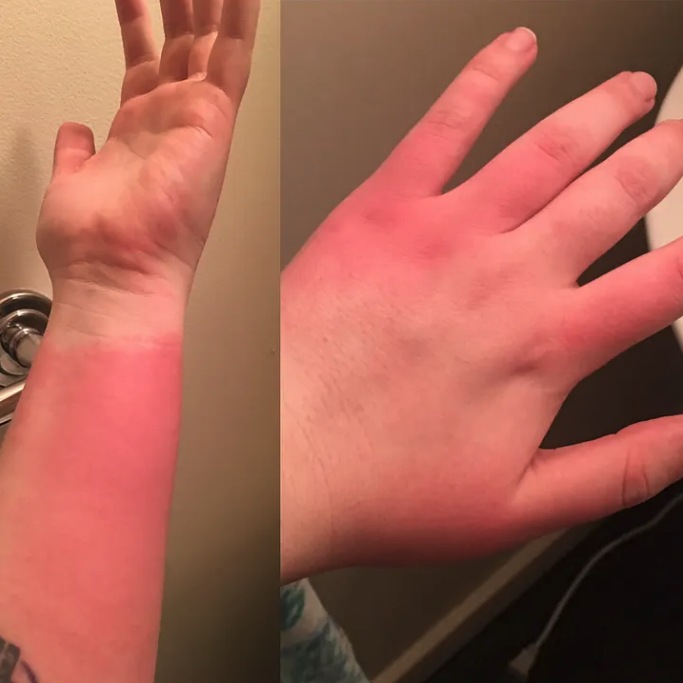
When my therapist told me I had PTSD, I half-argued with them about it. “There were so many other people who had it worse. I mean, somebody died. I just got maced and not even in the eyes, what right do I have to be traumatized about it?” My therapist stared at me for a moment and then asked me to reconsider what I had just said.
“Do you think that you have to die before you’re allowed to be traumatized?”
One of the worst things was that, when I was particularly stressed or experiencing sensory overwhelm, I would start to hear things from that day in my head — nasty things the other side had yelled or chanted. I couldn’t make it stop and dealt with it for months while feeling like an increasingly terrible person. Eventually, I had a meltdown in therapy about it. I didn’t want to think these things and I didn’t believe them and I didn’t know why they were playing on repeat in my head. That was the day I learned about audio flashbacks.2
I remember reading about the second Unite the Right rally in 2018, seeing that the permits were approved, and crying with my head in my hands. For a full month before the 2019 anniversary, I had nightmares multiple times a week. They weren’t always literal flashback nightmares; one of the really insidious things about PTSD is that it twists so many normal things into something they’re not. Sometimes you have a dream that seems like it should be a normal stress dream, but it feels like a PTSD nightmare in a way that’s impossible to articulate and you wake up in a cold sweat with live-wire nerves.
What I remember most from that month is my face hurting all the time, because my jaw was clenched with rage 24/7. Rage that, two years on, I (and many other people) had to struggle with nightmares and day-to-day triggers, while the people who did this just got to live their lives. More than that, even, as some of the people who were there (or who actively encouraged it3) were elevated to even higher political or cultural positions afterwards.
Thankfully, I’m doing better now. But, as evidenced by writing this, that day still weighs on my mind a lot. I see echoes of it, forward and back, everywhere. I’ve watched history get rewritten in real time — there are people that I know, who know I was there, who say that it wasn’t a white supremacist rally, or that they can’t say for sure whether it was or not. Nevermind what common sense, ample audio/video evidence from the day itself, or my actual lived experience suggests to the contrary.
In 2020, Garrett Foster was murdered, also by someone who drove a car into a crowd of protestors. The only reason I wasn’t there was because my roommate had a stomachache and we had a hard “no going to protests alone” rule. His murder (like many others from that summer4) wasn’t met with the condemnation that Heather Heyer’s received. Instead, memes circulated about an “antifa starter pack” with a coffin among the items pictured. Scrolling Facebook made me want to vomit. I went to a vigil the night after Garrett’s murder, and a man followed my roommate and I across downtown to my car, chasing us into the parking garage. I have no doubt he intended to seriously hurt or kill us. (Cue a fresh crop and genre of nightmares.) But we continued going to protests, narrowly avoiding being kettled and rounded up into a school bus with other protestors on the night Abbott called in the Texas National Guard.
I am very cognizant of how lucky I’ve been and how much of it is because of help from other people. At Charlottesville, the reason that we weren’t near (or at) the car attack when it happened is because a couple saw us walking back to our car after the dispersal order and asked if we needed help. They took us back to their apartment, gave us water and snacks, and let my friend (who had been maced in the face point-blank and spent an hour or so on the ground writhing in pain) shower there.
Three years after Charlottesville, in Austin, on that night with the national guard, I stopped to help a teenager who had been maced by cops. While I was flushing his eyes with saline,5 a stranger came up to tell us what streets to avoid as we went back to the car. The cops were on those streets dragging people into unmarked police cars, you see, in addition to the school bus we’d all seen silhouetted against the clouds of tear gas. Echoes.
Almost six years after that, I watched a woman get murdered in broad daylight by a masked paramilitary soldier. Suddenly people who spent years ignoring people driving their cars into protests (in fact, people who often encouraged it) wanted to talk about people being radicalized into weaponizing their cars. Echoes and echoes and echoes.
The older I get, the more I see how connected we all are and how one person’s death rips through so many threads, leaving a ragged abyss where a person once was. We all touch so many peoples’ lives, often in ways we don’t know or understand.
Every time I read about someone being murdered by cops or terrorists or ICE, it feels like staring into that abyss. I think about their mother, their father, their children, their partner, their coworkers, their friends. Who were the people they touched without realizing? Whose mourning would they be surprised by? And their loved ones — what does the shape of their lives look like, as they try to mend something that, in a just world, would still be whole?
Maybe it’s morbid, but when I have been so lucky, it only feels fair to remember them and think of these things. I have said that sometimes it feels inevitable that I will be murdered at a protest and vilified for my own death while the murderer walks free.6 I don’t want that to happen. I don’t want to die. Despite the best efforts of fascists and oligarchists, there are so many joys to live for. I love the people (and animals and plants) in my life. I love the nature all around me. I want to see my nephew grow up. But, sometimes, I still wonder what the odds are.
We are each the sum of so much — our ancestors, our friends and family, the plants and the land and the animals we grew up with. Every loss of life is an incalculable tragedy, as all of those connections are snuffed out at once. And yet, in every struggle for a better future, there is loss. I’ve sought out a lot of history over the last few years, both via genealogy and via seeking out lesser-represented voices. The perspective it grants is both inspiring and deeply humbling. So many people fought for literal centuries, against unimaginable odds and violence, knowing they wouldn’t live to see the better world they were fighting for. In the face of that knowledge, knowing how hard my ancestors fought for freedom, knowing how many people died for Black civil rights, knowing that indigenous people are still fighting for their land after hundreds of years of broken treaties…how can I give up before we’re all free? What right do I have to drown in hopelessness? (And who would it serve if I did?)
Despair is obedience. The system doesn’t need you to love it. It needs you to stop.
— Jermaine Fowler, The King We Don’t Teach7
Humans aren’t inherently bad. We exist surrounded by structures designed to punish altruism and optimism, ones that actively disincentivize solidarity. So much effort is expended to keep us stuck and suffocating, like the amber-trapped mosquito. And yet. And yet. And yet. We still try. We still fight. We still help each other. Not all of us, but a lot of us. As for the people who don’t try, I stand by what I said in a very earnest tumblr post five years ago: the worst among us don’t deserve to define humanity. We shouldn’t let them. And when we refuse to let them, we shine a light and show others how the world can be — how we can be.
That, I think, more than anything else, is what I want to remember about Charlottesville. Not just the horrors, the slow creeping dread, and watching that same style of violence become more commonplace, while too many people remain complacent. I want to remember the people who stopped to help us, the people who took us in, the people who put their bodies between fascists and clergy. I want history to remember them, and you, reader, I want you to remember them, too.
- Mostly other white people, to be clear. ↩︎
- Given that it was things I heard that day, it might sound silly that I didn’t make the connection on my own, but they just weren’t what I expected flashbacks to “feel” like. ↩︎
- Steve Bannon is one example. He also spoke at the “Unite the Kingdom” event last year where Elon Musk told the attendees that they have to “fight back or die.” ↩︎
- An incomplete list, but a few examples: Italia Marie Kelly, 22, murdered while walking to her car when leaving a protest. Summer Taylor, 24, murdered by someone who drove their car into a protest in Seattle. Robert Forbes, murdered under similar circumstances. Sean Monterrosa, 22, murdered by police while on his knees with hands above his waist. And of course, Joseph Rosenbaum and Anthony Huber, murdered by Kyle Rittenhouse. ↩︎
- Highly recommend carrying bottles of saline solution sold for contact users; they’re sterile and easy to control. More protest first-aid tips here. ↩︎
- As happened with Garrett Foster — the governor of Texas personally intervened to expedite his review and pardon process. He now walks free after serving approximately one year of a 25-year sentence. ↩︎
- Continued: “Hope was never the belief that things would turn out well. Hope was the refusal to let the outcome dictate the action.” See also: “If we choose hopelessness, despair will consume us, and instigating change will become increasingly difficult.” — Kelly Hayes, We Have to Move ↩︎